
What is Koryuen?
In this section, I explain what the name "Koryuen" indicates, and I also tell you about what I've been up to. This sectoin also includes the previous messages from me to viewers. Please read through this page, particularly if you are visiting this site for the first time.What is Koryuen?
"Koryuen" literally means a "garden with the scent of willow trees" in Japanese. "Koryu" is also homophonous with a Japanese word meaning "crossroad (of information or people)", and "en" indicates a "place". As the name suggests, the purpose of this site is to serve as a crossroad (or a source) of information from inside and outside of Japan about netsuke and other related objects, to facilitate further appreciation of netsuke. This site is created by Komada Makiko, whose father is a contemporary netsuke artist, Komada Ryushi. "Koryuen" is just the name of this website, and unfortunately it does not refer to any organizations or facilities.
About Komada Makiko, the Editor of Koryuen
[Brief Biography of Komada Makiko]
- Please note that my family name is Komada and that I am FEMALE!
- 1994
- B.A. in English, Dokkyo University, Saitama Japan
- 1996
- M.A. in English Studies, the Graduate School of Dokkyo University, Saitama Japan
- 1996 - 97
- Studied Linguistics at the Graduate School of University of Alberta, Canada (Rotary Foundation Scholarship)
- 1997 - present
- Freelance translator specializing in arts and crafts (from English to Japanese; from Japanese to English), writer in the field of netsuke and okimono carving
- Membership
- Board member and deputy secretary, Japan Netsuke Society (Nihon Netsuke Kenkyukai)
- Board member, International Netsuke Society
- Secretary, Japan Chapter of the International Netsuke Society
- Member, Society for Japanese Arts (the Netherlands)
- Member, Asiatic Society of Japan
- Board member, International Netsuke Society
[Major Translation Works]
- The Tobacco and Salt Museum, the exhibition catalog Snuff Containers, 1998.
- Mishima-Taisha Museum of Art Treasures, the exhibition catalog Contemporary Netsuke, 1998.
- The Museum of Fragrance, Toyoda, the exhibition catalog Snuff Containers: Chinese Snuff Bottles and European Snuffboxes, 2000.
- Chiba City Museum of Art, the exhibition catalog The Kinsey Collection: Contemporary Netsuke, 2001.
- POLA Research Institute of Beauty & Culture, the catalog Makeup and Makeup Utensils in Edo Period Japan, 2002.
- POLA Museum of Art, the exhibition catalog Radiant Women, Radiant Light, 2002.
- POLA Research Institute of Beauty & Culture, the catalog Female Beauty in Modern Japan: Makeup and Coiffure, 2003.
- POLA Research Institute of Beauty & Culture, the catalog Ages of Hair Modes: Coiffures and Hair Ornaments from the Renaissance to Art Deco, 2005.
- POLA Research Institute of Beauty & Culture, the catalog Unique and Playful Shapes: Perfume Bottles from the 20th Century, 2005.
- POLA Research Institute of Beauty & Culture, the catalog Red Jewels of the Silk Road: Turkmen Jewellery, 2006.
- Matthi Forrer, "Dutch Collectors on Deshima and Their Taste for Tea", Saitacha Bulletin, No. 6, 2006.
- POLA Foundation for the Promotion of Traditional Japanese Culture, Kirikane - The Inheritance of Solemn Decoration, The Japanese Tradition and Culture, No. 30, Special Edition, 2007.
- POLA Research Institute of Beauty & Culture, the catalog Women of Blossoming Radiance: Makeup and Travel in the 20th Century, 2007.
- POLA Research Institute of Beauty & Culture, the catalog The Story of the Fan: Western Fans and Women's Fashion, 2008.
- POLA Research Institute of Beauty & Culture, the catalog The Pleasure of Toilette, The Joy of Decoration: Silver Hand Mirrors of the Art Nouveau Period, 2009.
- Fuchu Art Museum, Collection Catalog (Supplement), 2010.
- University of Nagasaki, ed., Nagasaki Ware: Mikawachi, Hasami, Nagasaki Bunkensha, 2016.
- The Tobacco and Salt Museum, explanatory panels in the exhibition Netsuke and Sagemono, 2016.
- POLA Foundation for the Promotion of Traditional Japanese Culture, The Nagahama Hikiyama Festival, The Japanese Tradition and Culture, No. 40, Special Edition, 2017.
- POLA Research Institute of Beauty & Culture, Cosmetic Culture PLUS, Volume 10, Nihongami, 2017.
- POLA Foundation for the Promotion of Traditional Japanese Culture, Trail-blazer for Urushi - The work of Kazumi Murose, The Japanese Tradition and Culture, No. 41, Special Edition, 2017.
- Hiroshima Museum of Art, the exhibition catalog Netsuke: Stylish Accessories, Crafts of Edo, Special Presentation of The Prince Takamado Netsuke Collection, 2018.
- POLA Research Institute of Beauty & Culture, Fashion and Make-up of Edo Beauties Seen in Ukiyo-e Prints, 2018.
[Editing Work of English Text]
- Pamphlet (Japanese Traditional Performing Arts), Japan Pavilion, World Expo Shanghai 2010.
- Rokusho, vol. 4: Netsuke Past and Present, Maria Shobo, 2011.
- Pamphlet, the Museum of Logistics, Tokyo, 2014.
[Film Translation]
- Maki-e by KAZUMI MUROSE: Beauty Beyond Time (English version); planned by the POLA Foundation for the Promotion of Traditional Japanese Culture, produced by Mainichi Productions, 2018.
[Original Japanese Publications]
- "Led by Netsuke to Honkaku-ji Temple: Finding and Visiting the Grave of Mr. Inaba Tsuryu, the Author of Soken Kisho", Netsuke no Shizuku, No. 68, 2012, pp. 23-27.
- "Meigokaikai: The Origins and Anecdotes Involving the Names of Contemporary Netsuke Artists, I (Masatoshi, Ikku, Zanmai)", Netsuke no Shizuku, No. 69, 2013, pp. 20-26.
- "Meigokaikai: The Origins and Anecdotes Involving the Names of Contemporary Netsuke Artists, II (Meishu/Akihide, Ryushi)", Netsuke no Shizuku, No. 70, 2013, pp. 26-33.
- "Meigokaikai: The Origins and Anecdotes Involving the Names of Contemporary Netsuke Artists, III (Haruyuki, Ryusui, Yoko)", Netsuke no Shizuku, No. 71, 2014, pp. 39-49.
- "Meigokaikai: The Origins and Anecdotes Involving the Names of Contemporary Netsuke Artists, Supplementary Anecdotes on the Little Known World Ivory Carving and Yanaka School of Carvers, Mainly on Those Who Were Connected with the Komada Family", Netsuke no Shizuku, No. 72, 2014, pp. 3-8.
- Netsuke (Japanology Collection Series), Tokyo: Kadokawa Corporation, 2015.
- "Meigokaikai: The Origins and Anecdotes Involving the Names of Contemporary Netsuke Artists, IV (Isshu)", Netsuke no Shizuku, No. 74, 2015, pp. 26-30.
- "Meigokaikai: The Origins and Anecdotes Involving the Names of Contemporary Netsuke Artists, V (Hodo)", Netsuke no Shizuku, No. 75, 2016, pp. 25-28.
- "An Introduction to Netsuke with a Focus on Contemporary Netsuke", Mitaka City Gallery of Art, the exhibition catalog Netsuke, 2017.
- "Meigokaikai: The Origins and Anecdotes Involving the Names of Contemporary Netsuke Artists, VI (Mitsuyuki)", Netsuke no Shizuku, No. 77, 2017, pp. 30-34.
- "Report on the Netsuke Exhibition in Washington DC and the Netsuke Convention in Cologne", Netsuke no Shizuku, No. 78, 2017, pp. 2-11.
- "My Father's Studio", Netsuke no Shizuku, No. 79, 2018, pp. 18-19.
- "Contemporary Netsuke Exhibition at Mishima-taisha Museum", International Netsuke Society Journal, Vol. 19, No. 1, 1999, pp. 10-13.
- "The Little-Known World of Ivory Okimono Craftsmen", Transactions of the Asiatic Society of Japan, fifth series, volume 8, 2016, 2017.
- "Hidari-ba Blades", Lempertz auction catalog (2018).
- "The Little-Known World of Ivory Okimono Craftsmen", International Netsuke Society Journal, Vol. 38, No. 2, pp. 32-44, 2018
- "Art Names Talk, Signatures Speak: Masatoshi", International Netsuke Society Journal, Vol. 38, No. 3, pp. 34-37, 2018
[Talks and Demonstrations]
- Talk on netsuke in English at Waseda University: June 11, 2015; May 26, 2016; May 25, 2017.
- Talk titled "The System of the 'Division of Labor' in Ivory Carving from the Meiji Period to the Present Time" in Japanese with Ryushi at Japan Netsuke Society meeting, July 26, 2015.
- Talk titled "The Little-known World of the Craftsmen of Ivory Okimono (statuettes) and Netsuke from the 19th to the 20th Centuries" in English with Ryushi at the Asiatic Society of Japan meeting, September 28, 2015.
- Talk titled "Netsuke: The Microcosm in the Palm of Your Hand" in Japanese with Ryushi at Takanawa Library, Minato Ward, Tokyo, November 13, 2015.
- Talk and demonstration titled "Netsuke - Japan's Tiny Goodwill Ambassadors" in English with Ryushi at Japan Information & Culture Center, the Embassy of Japan in Washington DC, March 15, 2017.
- Talk and demonstration titled "Art in the Palm of Your Hand: Netsuke in Japanese Culture" in English with Ryushi at the Freer Gallery of Art (Smithsonian Institution), March 16, 2017.
- Talk titled "Evaluation and Challenges of Japanese Arts and Crafts in the World, Mainly Concerning Netsuke" in Japanese at the Symposium for Former Scholars of the Rotary Foundation Scholarship (District 2770, Saitama), September 1, 2018.
"Messages from Makiko"
- [Makiko Update: July 17, 2015]
It has almost been five months since my book Netsuke came out. Many people have given me warm comments on the book, for which I am extremely delighted! The compliments cover a wide range of aspects of the book; for instance, the illustrations and the design of the book are beautiful; the small size of the book is suitable for netsuke; the contents are fresh, covering unique topics such as highlights of netsuke, carving processes, materials, boxes, signatures as well as how to handle actual pieces.
I am happy that some readers seem to have actually visited exhibitions and other netsuke-related events. I also feel very honored that my book is not only sold at bookstores all over Japan, but also reviewed in newspapers and magazines, etc. I hope the book contributes to make netsuke known to a wider audience.
By the way, Dr. Mimura Kyoko, leading scholar of 'mingei' and President of the NPO that promotes international exchange of culture and arts, kindly invited me to give a short lecture on netsuke in English during a class of artistic crafts at Waseda University on June 11. Some fifty students from Japan and other countries were in attendance. Along with my talk, I showed the photos of various netsuke, as well as actual pieces of netsuke, inro, and carving tools.
The students eagerly listened to my talk, and asked many questions that were to the point. The whole event was very enjoyable, and was also a great learning experience for me. I am truly grateful to Dr. Mimura and the students for giving me such a wonderful opportunity!
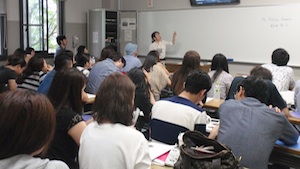
At the lecture: I am pointing to a netsuke photo shown on the overhead monitor. (Photo courtesy of Dr. Mimira Kyoko)
- [The 15th Anniversary and Big Announcement! February 20, 2015]
This year marks the 15th anniversary of Koryuen! Thanks are due to those who have visited this site and those who have given me the information on events and publications. I'd like to express my deepest gratitude to you all!
coincidentally, my introductory book on netsuke will be published on February 25, 2015! Please click here for details.
Thank you again for your visit and cooperation over the 15 years, and I hope you will continue to visit and support Koryuen!
- [Regarding the Recent Japan Earthquake (March 18, 2011)]
On March 11, 2011, a series of massive earthquakes and tsunami hit Tohoku and Kanto regions of Japan along the Pacific Rim. I would like to express my heartfelt sympathy to those who have been affected by the events.
I have received many messages from netsuke friends in and outside of Japan to care and encourage not only me and my family but also those who are in the damaged areas, and also the entire Japanese nation. I would like to express my sincere gratitude to them and to those who care about us Japanese.
Fortunately my family and I are all safe. Even in the north-west part of Chiba prefecture where we live, the quakes were so great that, during the first one, I thought our house might possibly collapse if the quake had continued. A few things got broken, but no serious damage to our house. Luckily all the lifelines are intact here in our neighborhood.
As of March 18, aftershocks are still continuing. During the first few days we felt them almost every 10 minutes. They are less frequent now, but we had relatively large aftershocks last night. Together with the worrying situation of the nuclear plants, our anxiety may last for some time.
It breaks our hearts to think about the victims and those who are not in the situation where they can enjoy netsuke as hobby or make netsuke as profession. On the other hand, those who are away from the affected areas are living normal life; and for the netsuke artists and dealers, the netsuke is a means of supporting themselves and their families. Considering those situations, I decided to keep updating information for more appreciation of netsuke on the website Koryuen as usual.
I believe that the netsuke has a refreshing and healing effect on our minds even in this time of hardship. I strongly hope that, soon a day will come when all the troubles cease and we (in and outside of Japan) can enjoy netsuke without anxiety.
- [Makiko Update: March 28, 2005]
Having commenced in March 2000, Koryuen now celebrates its FIFTH anniversary!!! Yippee!!! Due to my ever-increasing amount of translation work and other duties, updating of this site have unfortunately been quite irregular, but I know a lot of viewers have beared with me (I'm really sorry!), thanks to their patience, and visit my site repeatedly, for which I am very thankful.
Looking back these five years, I am filled with deep emotions - it began with a few pages, receiving a few hits per week, and then the site has had the "word of mouth" spread as well as some advertisements, making the number of contributors and visitors of the site grow so much - much more than I could imagine. I have received a lot of feedback and wonderful responses.
For instance, some netsuke aficionados told me that when they do "net-surfing", they always begin with Koryuen. Shop owners, exhibition organizers, and book sellers were pleased to tell me that they had some customers/visitors who learned of their events and publications through Koryuen.
It has been a rewarding experience for me to organize this site, and I am very pleased to be able to make contributions, however small they may be, to the growth of the field of netsuke in my own way.
To show my appreciation and mark the fifth anniversary, a new section has been added - it's called "Museums" to introduce museums and institutions around the world that have netsuke and other related objects. I hope it will be of interest to you.
Once again, I'd like to express my sincere gratitude to all of you who have visited and cooperated with my site during these five years, and I would like to ask for your continuous support!!!
- [Makiko Update: March 9, 2003]
I am so sorry for being slow in updating the site during the last year. I've got so much more translation work than ever before, which, along with other things, has kept me very busy... Interestingly, many of the translations that I did last year were related to lacquer ware, one of which was Makeup and Makeup Utensils in Edo Period Japan. More to come, and I'll keep you posted!! By the way, I'm not sure why it happened, but the access counter was reset sometime during last month. I remember it was over 20,000, and it's now about 460. How could that happen?? Anyway, I am grateful to you all for visiting my site!!
- [Makiko Update: December 31, 2001]
Today is the last day of the Internet Fair (Inpaku). I would like to express my gratitude to the organizers of this wonderful event, and my sincere thanks go to you and the rest of the visitors throughout the year. It was a great benefit for me to get to know a lot of people through the event, and their warm comments were very encouraging. It was also great to have a large number of visitors who found my site through Inpaku. Even though the Fair ends tonight, this Koryuen site continues, so please come visit again and again!! Today is also the last day of the year 2001. I wish you all have a peaceful new year!
- [Makiko Update: December 10, 2001]
I haven't been able to post a report on the Boston convention yet - I have been extremely busy with many duties, and I have only been able to update exhibition information and one or two other pages... Thank you for your patience. I said in August that Inpaku's vote would continue until the end of this year, but it was ended in November. If you have voted for my site, thanks a lot!!!
- [Makiko Update: September 29, 2001]
I was in Boston when the terrorists attacked the U.S. - it was the last day of the International Netsuke Society's convention. I was supposed to leave Boston on the 12th, but was stranded in the city for about a week with my parents (as well as many other people). I finally arrived in Japan safely on the 19th (I was and am still a bit tired, both physically and mentally...). The convention itself was very enjoyable, and I hope to post a report on it in this site later. In the meantime, I would like to express my sympathy to the Americans for what happened on September 11th.
- [Makiko Update: September 2001]
At the beginning of this month, the number of total accesses since April 21, 2000 reached 10,000!!! Isn't that great?!
- [Makiko Update: August 2001]
Gosh, time really flies! After I recovered from the bad cold, I worked hard to catch up my work schedule. Then I got a translation work of the exhibition catalog Contemporary Netsuke: The Kinsey Collection. The work was finished in late July, and the catalog is now on sale! (Yippee!) I'll make a mention of the catalog in the publication section soon. I've been to the exhibition five times already! The display is absolutely beautiful... By the way, International Netsuke society's Boston convention is just around the corner. Many interesting events including the netsuke exhibition at the Museum of Fine Arts in Boston are scheduled during the convention, and my parents and I are looking forward to it very much! Finally, the Inpaku office sent me a list of (randomly?) chosen messages that were submitted by those who voted for my site through the orange button (at the bottom of each page) by the end of June. I am very grateful for the warm, encouraging comments!!! Voting is on until December 31, 2001, so if you haven't voted yet, please consider doing it. Thanks! (Postscript: The orange button was removed at the end of the Inpaku period. I am grateful for those who have supported this site!)
- [Makiko Update: March 2001]
I am very sorry that I could not update this site for a long time. Through the middle of this month, I was terribly busy with the translation work that I mentioned above. Then, shortly after I finished it, I got a bad headache and high fever - maybe a flu or something, which kept me in bed for more than a week (sigh...). I am getting better, and I'll to get back to this site as soon as I'm fully recovered. Again, I'm sorry, and I sincerely thank you for your patience!
- [Big Announcement! December 22, 2000]
I hope everyone is enjoying a great holiday season!
I have a BIG announcement to make: this website will participate in the Internet Fair 2001 Japan (also called Inpaku) as a pavilion! The Fair will be held by the Japanese government from December 31, 2000 through December 31, 2001. It is an internet exposition, in which over two hundred interesting websites will be linked from the Inpaku site as pavilions on a wide variety of themes!
You might have noticed a small banner on the top-right corner in my webpages. It is an Inpaku's banner/button. Its design may be changed, but it will stay through the period of the Fair, indicating that these pages constitute an official pavilion.
My site will participate as an "open entry" site, as opposed to the "specific theme" sites that are built by central and local governments, NPO's, private companies, etc.
There will be some pavilions which focus on arts and crafts from Japan and around the world. I hope you will enjoy those wonderful sites as well as mine! I have some new exciting plans for this site during the period of the Fair, so please don't miss them!!!
Thank you for visiting my site this year, and I send you my very best wishes for the coming new year!
Post script: All the events associated with the Internet Fair was ended in success on December 31, 2001, and the Inpaku site was closed on January 31, 2002. The links from my site to the Inpaku site were also removed. I made some changes to the above announcement accordingly. I am very grateful for the encouragements and support that I received during the Fair. Many, many thanks to you all!
- [Makiko Update: December 2000]
I've been working hard on a large translation work plus a few other projects! I am hoping to have a relaxing time with family on new year's eve and new year's day, thought I may be wrapped up in the internet as the Internet Fair 2001 Japan (Inpaku) will begin on the 31st... (You can jump to the Fair by clicking the banner/button on the top-right corner of this page.)
- [Message commemorating the big update on September 29, 2000]
Hello, everyone! Welcome to Koryuen, the site for more appreciation of netsuke. I've been posting mentions of events and publications, exhibition reviews, etc. pertinent to antique and contemporary netsuke and other related objects, the information of which I think is useful to enjoy netsuke. This site is presented in Japanese and English, so that Japanese and non-Japanese people can share the same information, in the hope of serving as the publicity center of this unique art form and stimulating the circulation of domestic and international information about netsuke beyond the language barrier.
Since I opened this website over six months ago, my site has been very dynamic (I think!), thanks to the contributions by many people around the world and your visit to the site. Honestly, new information, encouraging comments, and the increase in the number of visits have been a source of energy for me to keep going.
Today, I am pleased to inform you that my site is greatly updated. I have decided that the tone of this site has been a little too formal . From this "update" onwards, I make it more lively and emphasize that this is my PERSONAL website.
Please go through ALL the contents even if it is not your first visit, because I've added something new to each section. And please come visit this site regularly, say, every week or so. I've been updating this site almost every week or every two weeks at the latest, and I am hoping to keep this pace.
Thank you for visiting, and I hope you enjoy my site!
| Koryuen Home | What is a Netsuke? | Exhibitions and Events | Publications |
| News and Views | Reports on Events | Netsuke Carving |
| Netsuke Organizations | Museums | Links | What is Koryuen? |
All rights reserved. Komada Makiko (c) 2000